Engineering beyond the model.
AI is only one part of the system.
My background is in economics and finance. Research with statistical and econometric methods led me to data analysis, then to machine learning, and from there to the software engineering that makes models useful in production.
Today I work on the layers around the model: APIs, databases, queues, infrastructure, integrations, data pipelines and the architecture that turns an AI capability into a reliable product. The goal is simple: systems that are useful in the real world, not just impressive in a demo.
I like understanding the whole system.

Experience
Software Engineer
HR Agent
Current
Production AI platform: backend services, queue-driven workers, LLM pipelines, real-time voice and Azure infrastructure.
AI Developer
Insightplay
2025
Multi-agent systems, FastAPI backends, vector retrieval and cloud deployments on AWS.
Data Analytics Intern
ProPacífico
2024
Interactive dashboards, data validation procedures and statistical analysis of project execution.
Recognition
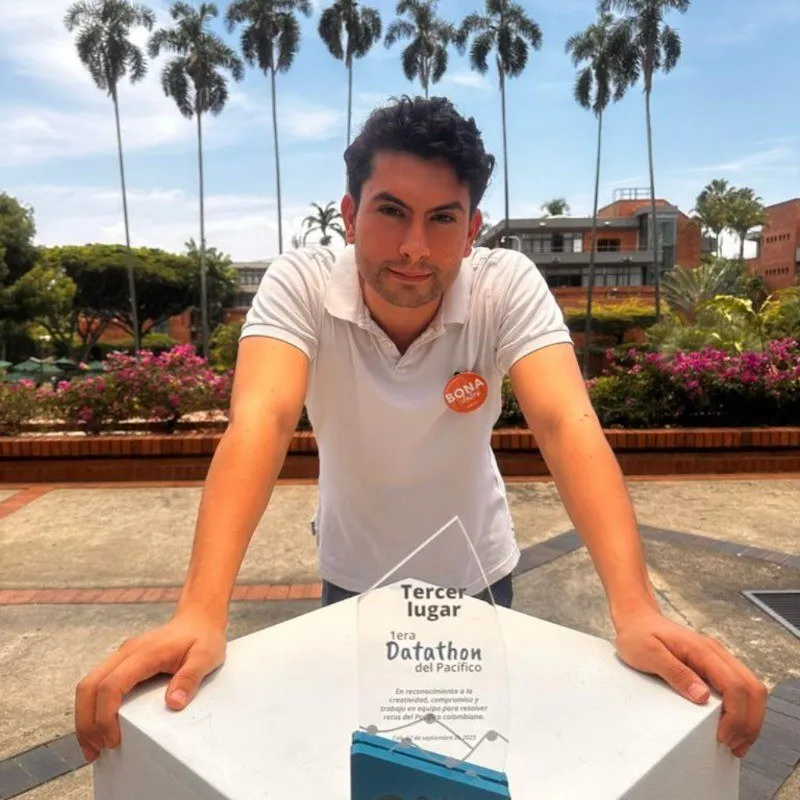
Third place, first Datathon del Pacífico
Regional data competition organised by ProPacífico. Cali, 2023.
Winner, Generative AI hackathon
A program that generates questions and evaluates reading, speaking and listening proficiency against the CEFR framework.
Best Presentation Award
V Latin American Congress on Social Marketing.
The model is one box.
A request through a typical production AI system. Hover or focus any component to see what it is there for.
The model is one box. Everything around it is what turns it into a product.
How I think about engineering
Understand the problem
Who is it for, what breaks today, and what would "working" look like.
Design the system
Components, contracts and failure modes before the first line of code.
Build the smallest useful version
Something real that runs end to end, then add complexity.
Integrate it with the real world
Existing data, APIs, infrastructure and the people who use it.
Measure, test and improve
Observe what it actually does, then go around the loop again.
Then back to the first step, with better information.
Where I work in the stack
AI engineering
Models as components with contracts, costs and failure modes.
- LLMs
- Generative AI
- NLP
- AI agents
- Local AI
- Small language models
Software engineering
The code that makes a capability dependable.
- Python
- Backend systems
- APIs
- Databases
- System design
- Software architecture
Cloud & infrastructure
Where it runs, how it ships, how you know it works.
- Azure
- Docker
- CI/CD
- Cloud infrastructure
- Production systems
Systems & automation
Connecting software to data, services and hardware.
- Automation
- Data processing
- Integrations
- MQTT
Education
Specialization in Software Engineering
Universidad Internacional de La Rioja (UNIR)
In progressEconomics and Finance
Universidad de San Buenaventura, Cali
2020 – 2024
Certifications
- Generative AI Engineering with LLMsIBM
- Advanced Data AnalyticsGoogle
Languages
- SpanishNative
- EnglishNative-level proficiency
- ItalianIntermediate